Leave Your Message

China Best Anchor Manufacturers for Global Buyers

Anchors are safety-critical equipment, yet buyers often compare them by price and catalogue weight alone. That is a thin basis for a consequential purchase. UNCTAD’s Review of Maritime Transport 2024 reports that global maritime trade grew by 2.4% in 2023, underscoring the scale of shipping activity these products support. The figure is not an anchor-market forecast. It does, however, help explain why dependable supply and verifiable manufacturing quality matter to shipyards, distributors, and vessel operators.

A useful supplier review looks beyond a factory’s website. Buyers should check whether the manufacturer can provide material traceability, dimensional inspection records, load-test documentation, and clear product specifications. For chain cables and related anchoring equipment, applicable standards and vessel-class requirements must be confirmed for the intended application. IACS Unified Requirements and classification-society rules can inform that review, but requirements vary by vessel and project. Ask for evidence, not just assurances.

Small details matter. A shackle pin that does not fit, incomplete coating records, or vague delivery terms can delay installation. Not glamorous, but important. This guide to China’s best anchor manufacturers for global buyers focuses on production capability, quality controls, certifications, export experience, and communication. A factory visit or independent inspection may offer useful evidence, though neither guarantees future performance. Buyers should compare suppliers against their own technical requirements and verify claims directly. The right choice is rarely the cheapest quotation. It is the supplier whose evidence, product fit, and after-sales support withstand careful checking.
China Best Anchor Manufacturers for Global Buyers

Understanding Anchor Types and Their Global Applications

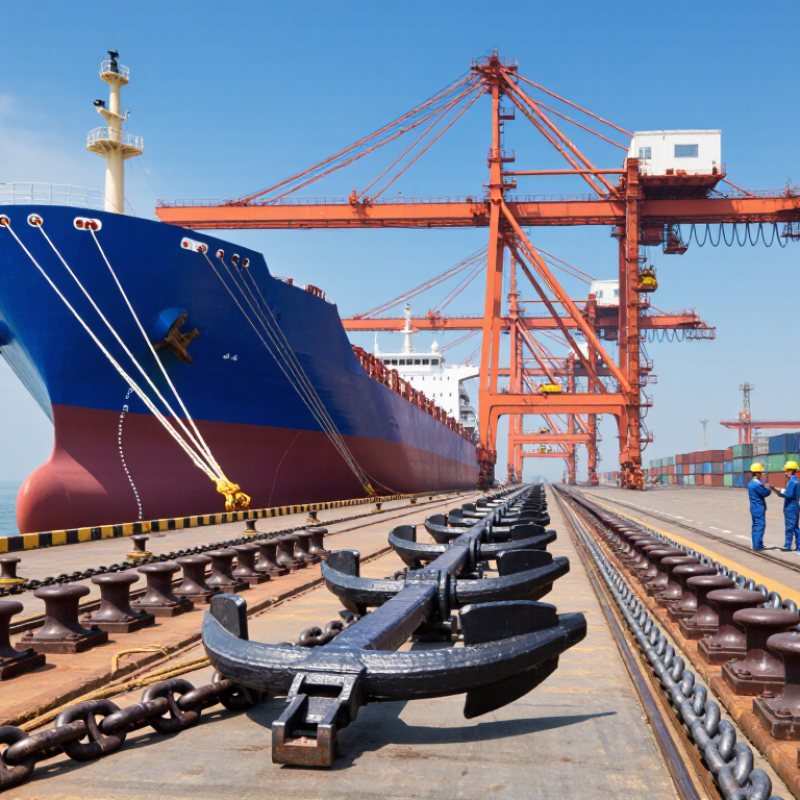
Anchor selection depends on the load, seabed, and installation method. Fluke anchors penetrate sand or mud and suit many small-vessel applications. Plow-style anchors can reset under changing loads. Heavy stockless anchors are common on commercial ships. For offshore mooring, drag-embedment anchors, suction piles, and driven piles serve different soil conditions. Concrete work uses another family: expansion anchors grip drilled holes, while adhesive anchors bond threaded rods into prepared concrete. These types are not interchangeable.

The scale of marine use is substantial. UNCTAD’s Review of Maritime Transport 2024 reports that over 80% of global trade by volume moves by sea. This makes reliable anchoring important in ports, vessels, and offshore infrastructure. The Global Wind Energy Council’s Global Wind Report 2024 records 117 GW of wind capacity added worldwide in 2023. Floating wind projects also require seabed mooring systems, selected for water depth, soil strength, and design loads.

A specification should name the anchor type, material, coating, rated load, and installation limits. Soil surveys matter. So do corrosion exposure and inspection access. A small fluke may hold well in firm sand but perform poorly in soft silt. Reality is messier than a product table suggests. Even experienced buyers can overlook installation equipment or site variability. Ask suppliers for test records and application details, then compare them against project conditions.
How to Evaluate Anchor Manufacturers in China

Evaluating anchor manufacturers in China starts with the application: concrete, masonry, and marine use require different materials and tests. Ask for product drawings, load ratings, installation limits, and the standards used. “High strength” is not evidence. Request material certificates tied to batch numbers, plus inspection records for dimensions, thread fit, and coating thickness.

Scale is not proof of consistency. World Steel Association data report that China produced 1,005.1 million tonnes of crude steel in 2024. This describes national output, not any factory’s anchor quality; treat it only as supply-chain context. Check how the manufacturer verifies incoming materials, controls production, and tracks finished lots.

Do not rely on one polished sample. Select units from normal production batches and verify them through an appropriately accredited independent laboratory. For concrete anchors, request pull-out results for the specified concrete strength and embedment depth. For coated products, check coating-thickness and corrosion-test records. A factory visit helps, but a quick tour may miss outsourced processes. Paperwork can look complete while batch links remain weak; investigate that gap.

China Best Anchor Manufacturers for Global Buyers - How to Evaluate Anchor Manufacturers in China
Evaluation Dimension What to Check Useful Evidence to Request Buyer Consideration
Product and application scope Confirm whether the supplier makes the required anchor type, such as anchor bolts, cast-in anchors, mechanical anchors, or adhesive anchor systems. Check dimensions, installation method, base material, and intended load conditions. Product drawings, dimensional specifications, installation instructions, and a written confirmation that the product matches the project specification. Products designed for different base materials or installation methods are not automatically interchangeable. Match the anchor to the application and design requirements.
Applicable standards Identify the exact standard and edition required for the product and its intended use. For example, ASTM F1554 covers anchor bolts used to anchor structural supports to concrete foundations; it does not cover every type of anchor. Standard references on the quotation and purchase order, product certificates, inspection records, and traceable test reports where required. Ask the supplier to confirm the grade, dimensions, and acceptance requirements against the project documents. A general claim of “international standard” is not a substitute for a specific standard designation.
Material and mechanical properties Verify the specified material, grade, strength class, heat treatment where applicable, and required mechanical properties. Ensure that the certificate refers to the supplied heat or production batch. Material test certificate, heat or batch number, chemical composition results, and mechanical test results required by the purchase specification. Do not compare products by nominal size alone. Material grade and mechanical properties must meet the design and applicable standard requirements.
Dimensions and tolerances Check diameter, length, thread form and length, head or plate dimensions, and any project-specific tolerances. Confirm the measurement method and inspection sampling plan. Approved drawings, inspection and test plan, dimensional inspection report, and sample measurements from production. Small dimensional differences can affect fit, embedment, installation, and compatibility with nuts, washers, or templates.
Corrosion protection Specify the required finish, such as plain, electroplated, or hot-dip galvanized, and confirm coating requirements for the application. ISO 1461 addresses hot-dip galvanized coatings on fabricated iron and steel articles; other product standards may apply to fasteners. Coating specification, coating inspection records, thickness or mass measurements where specified, and documentation identifying the coating process. Coating choice should reflect the environment and project specification. Confirm thread fit and assembly requirements for coated components.
Quality control and traceability Evaluate how incoming materials, production operations, inspection, nonconforming products, and batch records are controlled. ISO 9001 certification relates to a quality management system, not automatic approval of every product. Current quality-system certificate, process flow, inspection plan, calibration records where relevant, and examples of batch-level traceability documents. Verify that certificates are valid and cover the relevant manufacturing site and activities. Product-specific evidence should still be reviewed.
Testing and independent verification Determine which tests are required by the applicable product standard or project specification, and whether testing must be performed by an independent laboratory. Test reports showing the sample identification, test method, results, date, and laboratory details. Where required, check the laboratory’s relevant accreditation scope. ISO/IEC 17025 concerns the competence of testing and calibration laboratories. Accreditation should be checked for the relevant test and scope, not assumed from the certificate alone.
Production capacity and lead time Assess whether the supplier can meet the required quantity, delivery schedule, packaging instructions, and any inspection or documentation milestones. Written production schedule, order milestone plan, capacity confirmation for the specific order, and agreed shipping-ready date. Base planning on a confirmed order schedule and clearly defined delivery terms rather than an indicative lead-time estimate.
Packaging and export readiness Confirm protection against corrosion and transit damage, labeling, packing list details, and any destination-specific shipping or import documentation requirements. Packaging specification, sample shipping marks, commercial invoice and packing-list format, and agreed transport documents as applicable. Agree packaging and document requirements before production is complete to reduce customs, handling, and receiving delays.
Quotation and contract clarity Compare the complete offer, including product specification, quantity, unit of measure, tooling or testing charges, packaging, payment terms, delivery terms, and quotation validity. Itemized quotation and a purchase order that records the approved drawings, standards, inspection requirements, delivery terms, and change-control process. Evaluate offers on equivalent technical and commercial terms; a lower price may reflect a different material, coating, inspection scope, or delivery basis.

Leading Chinese Anchor Manufacturers for International Buyers

International buyers comparing Chinese anchor manufacturers should look beyond catalog photos. Anchor performance depends on vessel type, seabed, and operating conditions. A design suited to sand may behave differently on rock or mud. Details matter.

Ask manufacturers for material grades, dimensional drawings, production tolerances, and inspection records. Request evidence of load testing and welding checks where relevant. A clear traceability process helps buyers connect delivered products with their stated specifications. Small details count.

Communication is part of quality. Confirm coating requirements, packaging, lead times, and export documents before production begins. Photos of finished anchors can help, but they do not replace inspection records. A polished quotation may still leave gaps. Ask specific questions.

For a fair comparison, send each supplier the same technical brief and evaluate responses against measurable requirements. Discuss sample approval and how design changes are documented. Be realistic about schedules, especially when custom dimensions are involved. Even a careful process can miss something, so leave time to review drawings before approving production.

China’s Anchor Manufacturers: A Quality Reference for Global Buyers

Minimum average hot-dip zinc coating thickness by steel thickness, based on ISO 1461 requirements for non-centrifuged articles. This reference can help buyers assess coating specifications for galvanized steel anchor products.

Source: ISO 1461, Hot dip galvanized coatings on fabricated iron and steel articles — Specifications and test methods. Actual product requirements depend on the applicable specification and product design.

Manufacturing Standards and Quality Assurance

For global buyers, an anchor’s stated load capacity matters only when manufacturing controls support it. A dependable factory checks incoming steel or alloy against purchase specifications and ties material records to each production batch. Dimensions, thread fit, and surface finish should be checked with calibrated gauges, not visual judgment alone. Small details matter.

During production, operators can monitor forming, machining, and heat-treatment stages, while inspectors record deviations before parts move forward. Finished anchors should receive appropriate load or proof testing based on their design and intended use, with sample frequency documented. Coating thickness and adhesion also deserve checks; a shiny surface does not prove durable corrosion protection. No process is perfect.

Buyers can request inspection reports, material certificates, calibration records, and clear acceptance criteria. Confirm that test methods match the product specification and applicable market requirements, since standards vary by application and destination. Traceability helps teams isolate a batch if a field issue appears, rather than guessing across months of production. In production reviews, a checklist may look thorough, yet one overlooked thread dimension can still delay installation. That is worth remembering.

Sourcing, Pricing, and Exporting Anchors from China

For global buyers, sourcing anchors from China starts with a precise specification, not a price request alone. Include the anchor type, target weight, dimensions, material, finish, and intended application in your RFQ. A clear drawing helps suppliers quote comparable products. Ask how critical dimensions and welds are inspected, and request material or test records where relevant. Details matter.

Pricing depends on more than the unit cost. Tooling, order quantity, surface treatment, packaging, and inspection can all affect the quote. Compare offers using the same specifications and delivery terms. A low price may exclude export packing or testing, so ask for an itemized breakdown. For a first order, a sample or pre-production inspection can reveal fit and finish issues. It adds time, though, and does not guarantee every production unit will be identical.

Before shipment, confirm the agreed Incoterm, lead time, carton or pallet dimensions, and required export documents with the supplier and freight forwarder. Request photos of packaging; heavy steel anchors need secure restraint and protection from moisture during transit. Check destination-country import requirements and have a qualified marine professional verify that the selected anchor suits the vessel and operating conditions. I would not assume that a familiar design is suitable everywhere. Even careful specifications can leave room for interpretation, so keep approvals and changes in writing.